
Toolkit / Quick reference

Ward pocket card

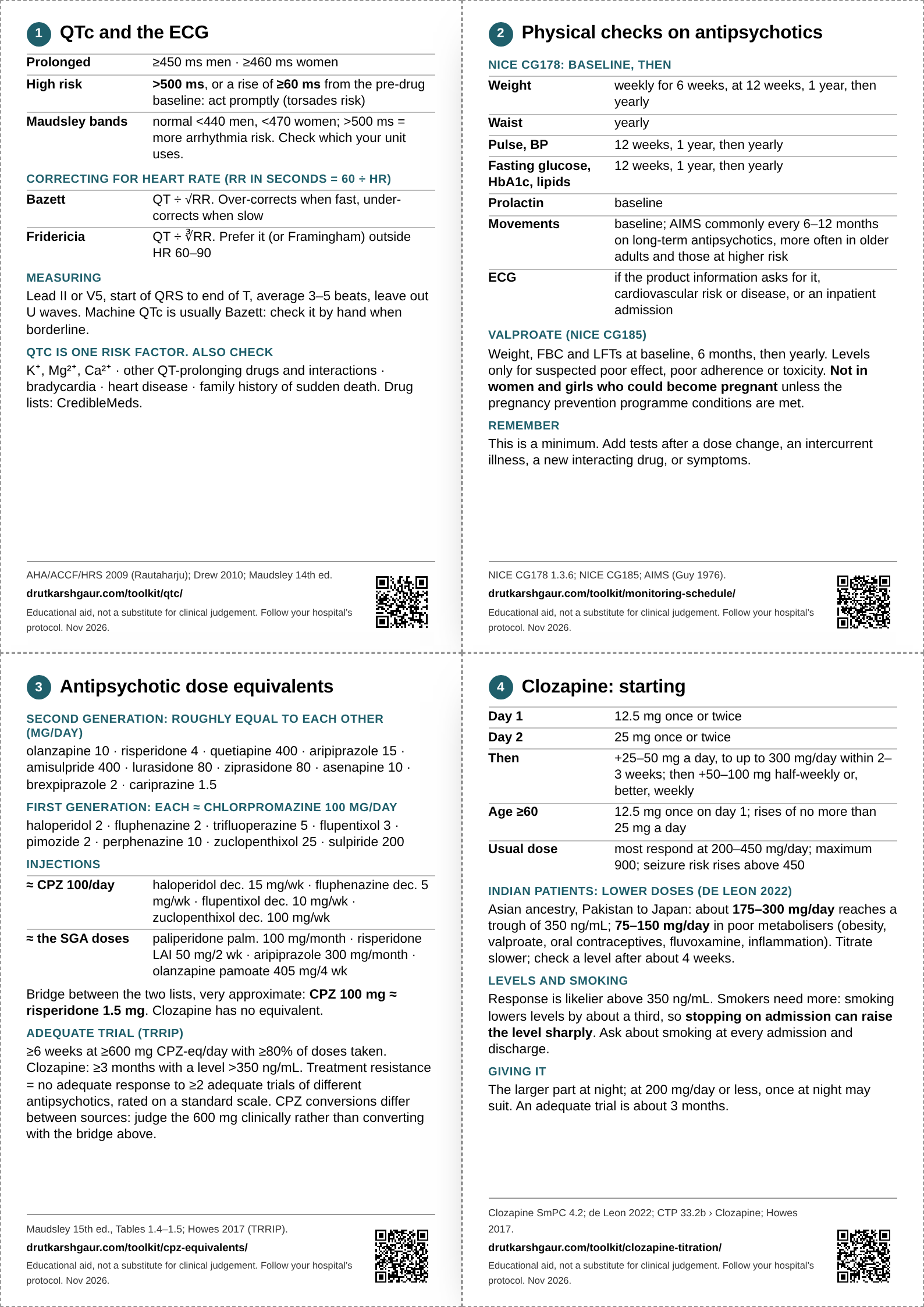
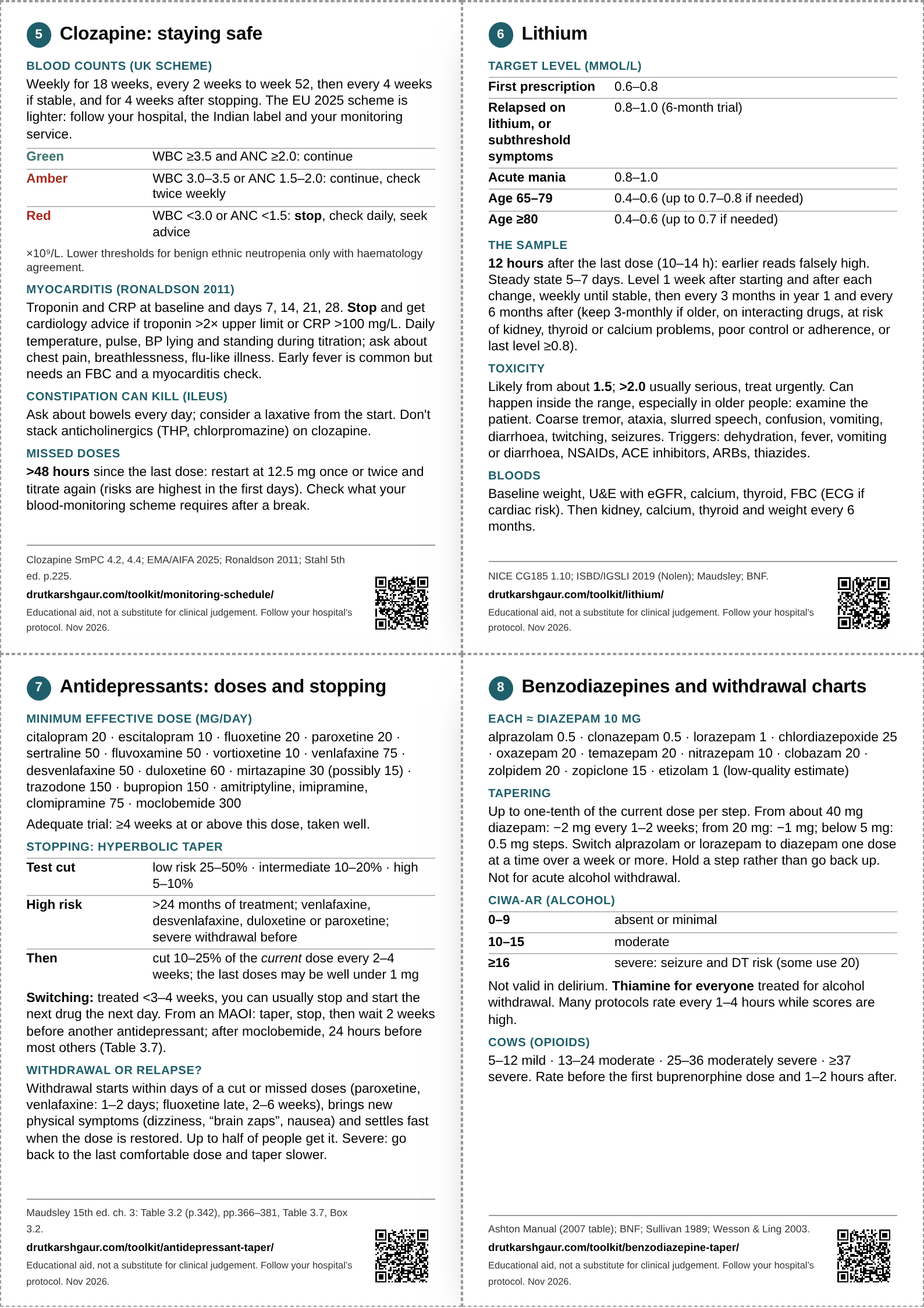
The numbers residents look up most on the ward, on eight small cards: QTc, physical checks, antipsychotic equivalents, clozapine, lithium, antidepressants and benzodiazepines. Print them for your coat pocket, or save the pictures to your phone. Each card links to the full tool.

Each A4 sheet holds four A6 cards. Print one or both sheets, cut along the dotted lines, and fold or laminate. The pictures are the same sheets as images, to keep on your phone or share in a WhatsApp group. Checked against the toolkit on 28 November 2026: if your hospital’s protocol differs, your protocol wins.

1

QTc and the ECG

Prolonged≥450 ms men · ≥460 ms women
High risk>500 ms, or a rise of ≥60 ms from the pre-drug baseline: act promptly (torsades risk)
Maudsley bandsnormal <440 men, <470 women; >500 ms = more arrhythmia risk. Check which your unit uses.

Correcting for heart rate (RR in seconds = 60 ÷ HR)

BazettQT ÷ √RR. Over-corrects when fast, under-corrects when slow
FridericiaQT ÷ ∛RR. Prefer it (or Framingham) outside HR 60–90

Measuring

Lead II or V5, start of QRS to end of T, average 3–5 beats, leave out U waves. Machine QTc is usually Bazett: check it by hand when borderline.

QTc is one risk factor. Also check

K⁺, Mg²⁺, Ca²⁺ · other QT-prolonging drugs and interactions · bradycardia · heart disease · family history of sudden death. Drug lists: CredibleMeds.

AHA/ACCF/HRS 2009 (Rautaharju); Drew 2010; Maudsley 14th ed.

2

Physical checks on antipsychotics

NICE CG178: baseline, then

Weightweekly for 6 weeks, at 12 weeks, 1 year, then yearly
Waistyearly
Pulse, BP12 weeks, 1 year, then yearly
Fasting glucose, HbA1c, lipids12 weeks, 1 year, then yearly
Prolactinbaseline
Movementsbaseline; AIMS commonly every 6–12 months on long-term antipsychotics, more often in older adults and those at higher risk
ECGif the product information asks for it, cardiovascular risk or disease, or an inpatient admission

Valproate (NICE CG185)

Weight, FBC and LFTs at baseline, 6 months, then yearly. Levels only for suspected poor effect, poor adherence or toxicity. Not in women and girls who could become pregnant unless the pregnancy prevention programme conditions are met.

Remember

This is a minimum. Add tests after a dose change, an intercurrent illness, a new interacting drug, or symptoms.

3

Antipsychotic dose equivalents

Second generation: roughly equal to each other (mg/day)

olanzapine 10 · risperidone 4 · quetiapine 400 · aripiprazole 15 · amisulpride 400 · lurasidone 80 · ziprasidone 80 · asenapine 10 · brexpiprazole 2 · cariprazine 1.5

First generation: each ≈ chlorpromazine 100 mg/day

haloperidol 2 · fluphenazine 2 · trifluoperazine 5 · flupentixol 3 · pimozide 2 · perphenazine 10 · zuclopenthixol 25 · sulpiride 200

Injections

≈ CPZ 100/dayhaloperidol dec. 15 mg/wk · fluphenazine dec. 5 mg/wk · flupentixol dec. 10 mg/wk · zuclopenthixol dec. 100 mg/wk
≈ the SGA dosespaliperidone palm. 100 mg/month · risperidone LAI 50 mg/2 wk · aripiprazole 300 mg/month · olanzapine pamoate 405 mg/4 wk

Bridge between the two lists, very approximate: CPZ 100 mg ≈ risperidone 1.5 mg. Clozapine has no equivalent.

Adequate trial (TRRIP)

≥6 weeks at ≥600 mg CPZ-eq/day with ≥80% of doses taken. Clozapine: ≥3 months with a level >350 ng/mL. Treatment resistance = no adequate response to ≥2 adequate trials of different antipsychotics, rated on a standard scale. CPZ conversions differ between sources: judge the 600 mg clinically rather than converting with the bridge above.

4

Clozapine: starting

Day 112.5 mg once or twice
Day 225 mg once or twice
Then+25–50 mg a day, to up to 300 mg/day within 2–3 weeks; then +50–100 mg half-weekly or, better, weekly
Age ≥6012.5 mg once on day 1; rises of no more than 25 mg a day
Usual dosemost respond at 200–450 mg/day; maximum 900; seizure risk rises above 450

Indian patients: lower doses (de Leon 2022)

Asian ancestry, Pakistan to Japan: about 175–300 mg/day reaches a trough of 350 ng/mL; 75–150 mg/day in poor metabolisers (obesity, valproate, oral contraceptives, fluvoxamine, inflammation). Titrate slower; check a level after about 4 weeks.

Levels and smoking

Response is likelier above 350 ng/mL. Smokers need more: smoking lowers levels by about a third, so stopping on admission can raise the level sharply. Ask about smoking at every admission and discharge.

Giving it

The larger part at night; at 200 mg/day or less, once at night may suit. An adequate trial is about 3 months.

Clozapine SmPC 4.2; de Leon 2022; CTP 33.2b › Clozapine; Howes 2017.

5

Clozapine: staying safe

Blood counts (UK scheme)

Weekly for 18 weeks, every 2 weeks to week 52, then every 4 weeks if stable, and for 4 weeks after stopping. The EU 2025 scheme is lighter: follow your hospital, the Indian label and your monitoring service.

GreenWBC ≥3.5 and ANC ≥2.0: continue
AmberWBC 3.0–3.5 or ANC 1.5–2.0: continue, check twice weekly
RedWBC <3.0 or ANC <1.5: stop, check daily, seek advice

×10⁹/L. Lower thresholds for benign ethnic neutropenia only with haematology agreement.

Myocarditis (Ronaldson 2011)

Troponin and CRP at baseline and days 7, 14, 21, 28. Stop and get cardiology advice if troponin >2× upper limit or CRP >100 mg/L. Daily temperature, pulse, BP lying and standing during titration; ask about chest pain, breathlessness, flu-like illness. Early fever is common but needs an FBC and a myocarditis check.

Constipation can kill (ileus)

Ask about bowels every day; consider a laxative from the start. Don't stack anticholinergics (THP, chlorpromazine) on clozapine.

Missed doses

>48 hours since the last dose: restart at 12.5 mg once or twice and titrate again (risks are highest in the first days). Check what your blood-monitoring scheme requires after a break.

Clozapine SmPC 4.2, 4.4; EMA/AIFA 2025; Ronaldson 2011; Stahl 5th ed. p.225.

6

Lithium

Target level (mmol/L)

First prescription0.6–0.8
Relapsed on lithium, or subthreshold symptoms0.8–1.0 (6-month trial)
Acute mania0.8–1.0
Age 65–790.4–0.6 (up to 0.7–0.8 if needed)
Age ≥800.4–0.6 (up to 0.7 if needed)

The sample

12 hours after the last dose (10–14 h): earlier reads falsely high. Steady state 5–7 days. Level 1 week after starting and after each change, weekly until stable, then every 3 months in year 1 and every 6 months after (keep 3-monthly if older, on interacting drugs, at risk of kidney, thyroid or calcium problems, poor control or adherence, or last level ≥0.8).

Toxicity

Likely from about 1.5; >2.0 usually serious, treat urgently. Can happen inside the range, especially in older people: examine the patient. Coarse tremor, ataxia, slurred speech, confusion, vomiting, diarrhoea, twitching, seizures. Triggers: dehydration, fever, vomiting or diarrhoea, NSAIDs, ACE inhibitors, ARBs, thiazides.

Bloods

Baseline weight, U&E with eGFR, calcium, thyroid, FBC (ECG if cardiac risk). Then kidney, calcium, thyroid and weight every 6 months.

7

Antidepressants: doses and stopping

Minimum effective dose (mg/day)

citalopram 20 · escitalopram 10 · fluoxetine 20 · paroxetine 20 · sertraline 50 · fluvoxamine 50 · vortioxetine 10 · venlafaxine 75 · desvenlafaxine 50 · duloxetine 60 · mirtazapine 30 (possibly 15) · trazodone 150 · bupropion 150 · amitriptyline, imipramine, clomipramine 75 · moclobemide 300

Adequate trial: ≥4 weeks at or above this dose, taken well.

Stopping: hyperbolic taper

Test cutlow risk 25–50% · intermediate 10–20% · high 5–10%
High risk>24 months of treatment; venlafaxine, desvenlafaxine, duloxetine or paroxetine; severe withdrawal before
Thencut 10–25% of the current dose every 2–4 weeks; the last doses may be well under 1 mg

Switching: treated <3–4 weeks, you can usually stop and start the next drug the next day. From an MAOI: taper, stop, then wait 2 weeks before another antidepressant; after moclobemide, 24 hours before most others (Table 3.7).

Withdrawal or relapse?

Withdrawal starts within days of a cut or missed doses (paroxetine, venlafaxine: 1–2 days; fluoxetine late, 2–6 weeks), brings new physical symptoms (dizziness, “brain zaps”, nausea) and settles fast when the dose is restored. Up to half of people get it. Severe: go back to the last comfortable dose and taper slower.

8

Benzodiazepines and withdrawal charts

Each ≈ diazepam 10 mg

alprazolam 0.5 · clonazepam 0.5 · lorazepam 1 · chlordiazepoxide 25 · oxazepam 20 · temazepam 20 · nitrazepam 10 · clobazam 20 · zolpidem 20 · zopiclone 15 · etizolam 1 (low-quality estimate)

Tapering

Up to one-tenth of the current dose per step. From about 40 mg diazepam: −2 mg every 1–2 weeks; from 20 mg: −1 mg; below 5 mg: 0.5 mg steps. Switch alprazolam or lorazepam to diazepam one dose at a time over a week or more. Hold a step rather than go back up. Not for acute alcohol withdrawal.

CIWA-Ar (alcohol)

0–9absent or minimal
10–15moderate
≥16severe: seizure and DT risk (some use 20)

Not valid in delirium. Thiamine for everyone treated for alcohol withdrawal. Many protocols rate every 1–4 hours while scores are high.

COWS (opioids)

5–12 mild · 13–24 moderate · 25–36 moderately severe · ≥37 severe. Rate before the first buprenorphine dose and 1–2 hours after.

How to use it

  • A memory aid, not a protocol. Every line is condensed from a tool in this toolkit, where you will find the full notes, the exceptions and the calculator itself.
  • Guidelines differ between countries and hospitals (for example the UK and EU clozapine blood schemes, or where QTc bands are drawn). Where your hospital, the Indian product label or your monitoring service says something different, follow them.
  • Doses are for adults unless stated. Check the product information for children, pregnancy, and kidney or liver disease.
  • Abbreviations: ANC, absolute neutrophil count; CPZ-eq, chlorpromazine equivalents; DT, delirium tremens; LAI, long-acting injection; SGA, second-generation antipsychotic; THP, trihexyphenidyl; ULN, upper limit of normal.

References

  1. Rautaharju PM, et al. AHA/ACCF/HRS recommendations for the standardization and interpretation of the electrocardiogram, Part IV: the QT interval. Circulation. 2009;119(10):e241–e250.
  2. Drew BJ, et al. Prevention of torsade de pointes in hospital settings. Circulation. 2010;121(8):1047–1060.
  3. National Institute for Health and Care Excellence. Psychosis and schizophrenia in adults (CG178). 2014.
  4. National Institute for Health and Care Excellence. Bipolar disorder: assessment and management (CG185). 2014.
  5. Nolen WA, et al. Optimal serum level for lithium in maintenance treatment: ISBD/IGSLI Task Force. Bipolar Disord. 2019;21(5):394–409.
  6. Taylor DM, Barnes TRE, Young AH. The Maudsley Prescribing Guidelines in Psychiatry. 15th ed. Wiley-Blackwell; 2025. Tables 1.4–1.5 (equivalent doses); chapter 3 (Table 3.2 p.342, pp.366–381, Table 3.7, Box 3.2).
  7. Taylor DM, Barnes TRE, Young AH. The Maudsley Prescribing Guidelines in Psychiatry. 14th ed. Wiley-Blackwell; 2021 (QTc bands).
  8. Howes OD, et al. Treatment-resistant schizophrenia: TRRIP Working Group consensus guidelines. Am J Psychiatry. 2017;174(3):216–229.
  9. Clozapine tablets: summary of product characteristics (UK/EU), sections 4.2 and 4.4.
  10. Italian Medicines Agency (AIFA) / EMA. Clozapine: updated recommendations on blood monitoring. 8 September 2025.
  11. de Leon J, et al. An international adult guideline for making clozapine titration safer by using six ancestry-based personalized titrations. Pharmacopsychiatry. 2022;55(2):73–86.
  12. Ronaldson KJ, et al. A new monitoring protocol for clozapine-induced myocarditis. Aust N Z J Psychiatry. 2011;45(6):458–465.
  13. Stahl SM. Stahl’s Essential Psychopharmacology. 5th ed. Cambridge University Press; 2021. Chapter 5 (p.225).
  14. Sadock BJ, Ahmad S, Sadock VA, eds. Kaplan & Sadock’s Comprehensive Textbook of Psychiatry. 11th ed. Section 33.2b › Clozapine.
  15. Ashton CH. Benzodiazepines: How They Work and How to Withdraw (The Ashton Manual); equivalence table revised 2007.
  16. Joint Formulary Committee. British National Formulary: benzodiazepine withdrawal; lithium monitoring.
  17. Sullivan JT, et al. The revised Clinical Institute Withdrawal Assessment for Alcohol scale (CIWA-Ar). Br J Addict. 1989;84(11):1353–1357.
  18. Wesson DR, Ling W. The Clinical Opiate Withdrawal Scale (COWS). J Psychoactive Drugs. 2003;35(2):253–259.
  19. Guy W. ECDEU Assessment Manual for Psychopharmacology (AIMS). 1976.

An educational aid for clinicians, not a substitute for clinical judgement. Check doses and thresholds against the current product information and your hospital’s protocol before acting on them.

Spotted an error in this card?

Please don’t include any patient details.